 |
Still from the video The Other Side.
|
Showing posts with label events. Show all posts
Showing posts with label events. Show all posts
Dust / Gerald Nicosia / Kerouac's Ghosts
CRASSH
Following on from our successful research 2016-2017 seminar series at CRASSH (Centre for Research in the Arts, Humanities and Social Sciences), part of the University of Cambridge, we have been awarded support for a second seminar sequence. This will cover the next academic year, 2017-2018. Full details can be found here. For an overview of the group at CRASSH click here.
Child Be Strange / Penda's Fen
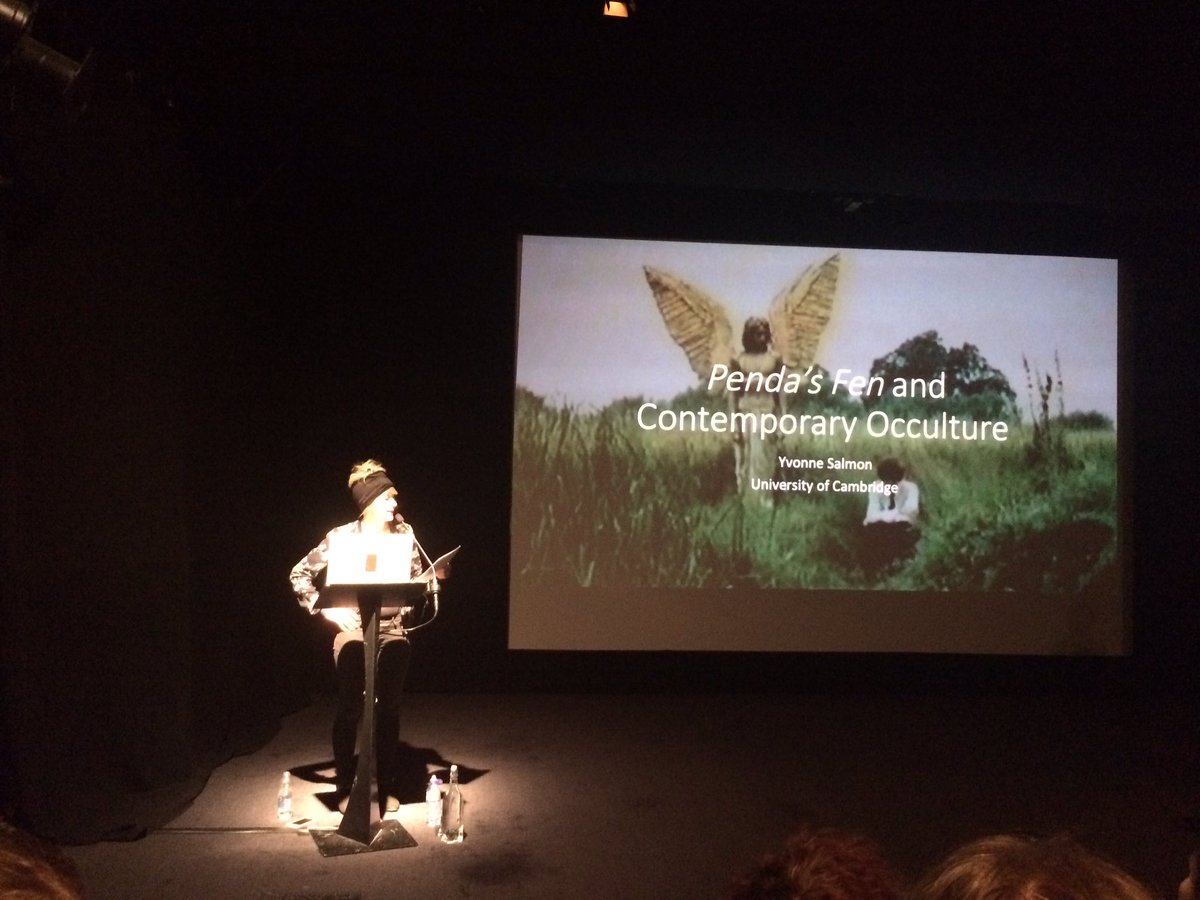 |
Yvonne Salmon at the BFI
In June, Yvonne Salmon was invited to take part in 'Child Be Strange', a special one-day symposium at the British Film Institute looking at Alan Clarke's Penda's Fen (1974). Yvonne spoke on 'Penda's Fen and Contemporary Occulture'. A publication from Strange Attractor Press is forthcoming. Original event flyer text added below.
*
Child Be Strange: A Symposium on Penda's Fen.Featuring a Q&A with screenwriter David Rudkin Including contributions from: Roger Luckhurst (Birkbeck), Yvonne Salmon (Cambridge University), Will Fowler (BFI), Gareth Evans (Whitechapel Gallery), and more tbc. When Alan Clarke’s Penda’s Fen was first broadcast in 1974 as a BBC ‘Play for Today’, The Times commented that it was a “major work of television” and praised David Rudkin’s writing for its “beauty, imagination and depth.” Including the film in its 2011 selection of the best 100 British films, Time Out magazine described Penda's Fen as a “multi-layered reading of contemporary society and its personal, social, sexual, psychic and metaphysical fault lines.” It has since been recognized as an extraordinary contribution to 1970s counter-cultural investigations of alternative ‘pagan’ histories of landscape, myth, theology and psyche at a crucial transitional moment in post-war Britain. The film vanished into unseen cult status, but after decades of unavailability the BFI has released Penda’s Fen on Blu-ray and DVD. This one-day symposium seeks to bring together academics, writers, and artists from across different fields to excavate this weird and wonderful cultural artefact. |
Ben Wheatley / Freefire
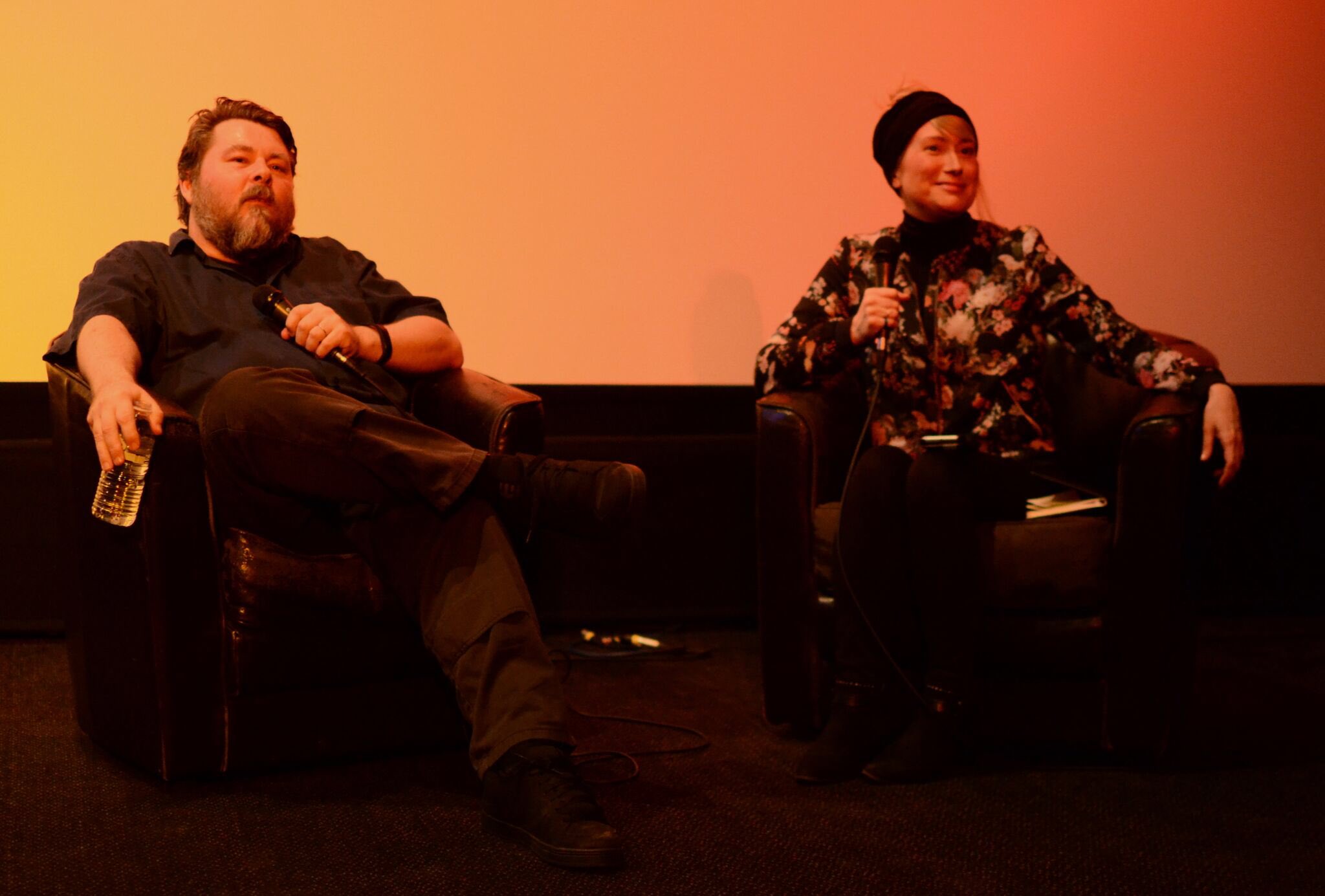 |
Ben Wheatley and Yvonne Salmon in conversation at the Picturehouse, Cambridge. Image: Picturehouse via Twitter.
Yvonne Salmon was delighted to be invited to interview Ben Wheatley as part of his promotional tour to support Freefire (2017). The sell-out event on March 30th generated some fabulous questions and the film was very well received. Having instigated the Alchemical Landscape project with a special screening and symposium on A Field in England (2013), and previously organised a Q+A to support High Rise (2016) Salmon is an expert on Wheatley's work.
|
Invisible Landscapes
We were very happy to work with Yelena Popova on Invisible Landscapes, a joint screening of video works. This was held at the Grange Cottage at Girton College as part of Yelena's artistic residency at Cambridge. Scroll down for the original event flyer text.
 |
Still from Ghost Walk.
*
INVISIBLE LANDSCAPES:
An Evening of Short Films by Yelena Popova, Yvonne Salmon & James Riley.
7pm Thursday 4th May, Grange Cottage Studio, Girton College Main Site.
Invisible Landscapes is a curated film programme featuring work by
Girton's Artist in Residence Yelena Popova and the directors of the
ongoing Alchemcial Landscape project, Yvonne Salmon & James Riley.
With a shared interest in landscape, architecture and psychogeography,
these films use word and image to look at some of the hidden forces
that underpin our notions of place.
Films to be shown include:
Yelena Popova:
Particulate Matter, Unnamed.
Yvonne Salmon & James Riley: Ghost Walk, Distress Signals, Territories, The Bird, Codebreaker.
The screening will be introduced by the film-makers and will feature a
short Q+A session.
All welcome.
|
Headlands
One of our ongoing projects is Headlands. This has been developed and designed by Yvonne Salmon and James Riley as a multi-platform work encompassing expanded cinema, spoken word, field research, a curated exhibition and various publications.
The project looks at the folkloric and ufological intersections that exist between two villages in North Cornwall: Port Isaac and St. Teath.
We mounted the project as an exhibition at the Faculty of English, University of Cambridge from 23rd June to 11th July 2016. This was followed by an live event at the Festival of Ideas on October 22nd, 2017. A trailer for the live event can be found here. We are now preparing the piece for release as a book and album on Eighth Climate Records. Further live performances are planned for the future . Scroll down for images and the promotional text for the original exhibition.
In 2015 Yvonne Salmon and James Riley travelled through North Cornwall. They went in search of evidence pertaining to two fictional and folkloric events: the filming of the sci-fi drama The Nightmare Man (1981) in Port Isaac and the 1645 'abduction' of Ann Jefferies from the nearby hamlet of St. Teath.
A series of material and symbolic factors connect these two episodes. They also lie at the intersection of place, culture and myth that characterises Cornwall's particular psychic territory.
Influenced by Patrick Keiller and the Robinson Institute, Headlands presents a series of texts, images and magical objects. Drawing on Yvonne Salmon's work as an artist and James Riley's experience with private archives, it is intended as an essay by way of artefacts, a dispatch from the zone.
You can see this exhibition on the first floor landing of the English Faculty building from 23rd June to 11th July 2016.
Yvonne Salmon and James Riley will be on the first floor landing at 1pm on Thursday 30th June. They will be happy to talk through the exhibition with any interested parties.
Headlands is presented as an output of the ongoing research project The Alchemical Landscape. It has been timed to coincide with 'The Alchemical Landscape II: Screen Media, Occulture and the Geographic Turn', a one day symposium at Girton College, Cambridge on 7th July. An event linked to the Headlands exhibition will be presented as part of the 2016 Festival of Ideas. The Alchemical Landscape Project has been awarded CRASSH research group status and will run a seminar series during the academic year 2016-2017.
The project looks at the folkloric and ufological intersections that exist between two villages in North Cornwall: Port Isaac and St. Teath.
We mounted the project as an exhibition at the Faculty of English, University of Cambridge from 23rd June to 11th July 2016. This was followed by an live event at the Festival of Ideas on October 22nd, 2017. A trailer for the live event can be found here. We are now preparing the piece for release as a book and album on Eighth Climate Records. Further live performances are planned for the future . Scroll down for images and the promotional text for the original exhibition.
*
 |
| Headlands Hotel, Port Isaac, Cornwall |
 |
| Tintagel, Cornwall |
 |
| Field work: Salmon shooting in St. Teath |
*
Headlands - A New Exhibition on the First Floor
In 2015 Yvonne Salmon and James Riley travelled through North Cornwall. They went in search of evidence pertaining to two fictional and folkloric events: the filming of the sci-fi drama The Nightmare Man (1981) in Port Isaac and the 1645 'abduction' of Ann Jefferies from the nearby hamlet of St. Teath.
A series of material and symbolic factors connect these two episodes. They also lie at the intersection of place, culture and myth that characterises Cornwall's particular psychic territory.
Influenced by Patrick Keiller and the Robinson Institute, Headlands presents a series of texts, images and magical objects. Drawing on Yvonne Salmon's work as an artist and James Riley's experience with private archives, it is intended as an essay by way of artefacts, a dispatch from the zone.
You can see this exhibition on the first floor landing of the English Faculty building from 23rd June to 11th July 2016.
Yvonne Salmon and James Riley will be on the first floor landing at 1pm on Thursday 30th June. They will be happy to talk through the exhibition with any interested parties.
Headlands is presented as an output of the ongoing research project The Alchemical Landscape. It has been timed to coincide with 'The Alchemical Landscape II: Screen Media, Occulture and the Geographic Turn', a one day symposium at Girton College, Cambridge on 7th July. An event linked to the Headlands exhibition will be presented as part of the 2016 Festival of Ideas. The Alchemical Landscape Project has been awarded CRASSH research group status and will run a seminar series during the academic year 2016-2017.
Symposium II
Our second symposium was held in July 2016 at Girton College, Cambridge. Scroll down for a set of images from the day. Follow this link for details of the speakers and the papers.
 |
| Christopher Josiffe speaking about Gef. |
 |
| Andy Sharp aka English Heretic |
 |
| Liberty Rowley of Four Feet Films |
 |
| Marc Atkins and Rod Mengham |

 |
| Lewis Wynn |
Upcoming Event: The Alchemical Landscape II
 |
| Image: James Riley |
This will be held at Girton College, University of Cambridge on Thursday 7th July, 2016.
Further details and the final programme can be found at the
Symposium II page.

The Other Side
 |
| Bishop James Pike |
The event features a series of acts and performances connected via a shared interest in the mediumistic power of recording technology:
Howlround
Documents
Evie Salmon & James Riley performing 'Dust'
bad timing djs: mix tapes from the underground
We'll be holding the event at the Judith E. Wilson Drama Studio, Faculty of English, 9 West Road, Cambridge on Thursday 12th May, 7.30pm.
Tickets are free but places are limited. Please reserve via eventbrite:
https://www.eventbrite.co.uk/e/the-other-side-an-audiophonic-seance-tickets-24826139652
We're also inviting you to consider a £5 donation towards performers' travel costs.
For more information, see the Bad Timing website and scroll down for details of each act.
*
Howlround is an ongoing exploration of the possibilities of magnetic tape as a creative medium for electronic music. Their live performances and compositions are created entirely by manipulating tape loops of natural acoustic sounds on vintage reel-to-reel machines, with additional reverb or electronic effects strictly forbidden. Their fourth LP Tales From the Black Tangle was released at the end of 2015 and was a dark and compelling concoction of industrial sirens, foghorns, seawash, ship to shore distress signals and even the creaking of a Broadcasting House microphone cradle in need of some oil.
'Uncanny, mesmerising, difficult and sublime' The Quietus
http://
Documents is a nascent development of the long running creative occult project English Heretic. Documents has been set up to explore a remit of ethnographic recordings from the imaginal world. Combining the aesthetic of Bataille's surrealist journal Documents with the hermetic psychology of James Hillman, the project represents a deepening of the themes laid out by English Heretic. Documents first broadcast was released on the Eighth Climate imprint in December 2015.
Documents will perform two pieces. "Music For The Execution Of Geoffrey Firmin" An imaginary séance for the tragic protagonist of Malcolm Lowry's Under The Volcano abstracting dialogue from the film adaptation of Lowry's book to achieve rapport the spectre of Firmin. "Last Broadcast at Boleskine" manipulates field recordings taken at the cemetery overlooked by Aleister Crowley's notorious Loch Ness home. These recordings, carried out on the 1st December 2015, anniversary of Crowley's death, shortly before Boleskine House burned down, constitute music to precipitate the violent demise of an abode on the borderland. Together these pieces explore landscape, film and documentary dialogue as a form of theatrical EVP.
http://
Evie Salmon and James Riley work across multiple faculties at the University of Cambridge. They co-direct The Alchemcial Landscape, an ongoing research and public engagement project looking at occulture and geography.
'Dust' is a speculative investigation into the afterlife of two lost recordings by Jack Kerouac and William Burroughs. Spoken word, archival murmurings and dead formats.
http://
http://
bad timing djs mix tapes: experiments from the underground
*
A note on the image above: Bishop James Pike (1913-1969) was an American Episcopal Minister, one of the first to make regular television appearances. Following the death of his son in 1966, Pike began to experience paranormal phenomena. In 1967 he appeared with the medium Arthur Ford as part of a television seance to contact his son. These experiences formed the basis of his book The Other Side (1969). Philip K. Dick based the character of Timothy Archer on Pike when he wrote his novel The Transmigration of Timothy Archer (1982).
Pike and his book will not be directly referenced on May 12th, but for obvious reasons his symbolic life has informed some of the thinking behind the event.
High-Rise

High Rise +
Q&A with Producer Jeremy Thomas & Yvonne Salmon
Cambridge Picturehouse,
Saturday 12th March, 6.00pm
Saturday 12th March, 6.00pm
We are delighted to welcome renowned producer Jeremy Thomas
for a Q&A
with Cambridge
University
"The brutalism begins with the architecture and extends
all the way
down to the residents." - Variety
"The kind of cinematic madness we desperately
need." - The Independent
"Serves up an orgiastic mayhem on a silver
platter." - The Telegraph
J. G. Ballard’s dystopian novel about society disintegrating
within a
giant tower block is brought to the screen by the maverick
writer-director partnership of Amy Jump and Ben Wheatley (Kill
List, Sightseers).
Awarded his biggest budget yet, Wheatley ushers on
board established stars and ace production designer Mark
Tildesley (The
Constant Gardener, 28
Days Later). Dr Robert Laing (Tom Hiddleston), an
affluent new tenant of the titular high-rise, quickly
attracts the
attentions of neighbour Charlotte (Sienna Miller) and then
of Helen
(Elisabeth Moss), who happens to be married to the socially
stratified
community’s resident troublemaker (Luke Evans).
As tensions build, the brutalist tower that its architect (a
supremely
laconic Irons) imagined would be “a crucible for change”
gradually
descends into anarchy in this great-looking, darkly
hilarious drama.
To book your ticket to the event, click here:
Disinformation Sound Archive
Over at Rorschach Audio: Art & Illusion for Sound, Joe Banks reported a fascinating broadcast featuring much of the Disinformation Sound Archive:
From 8pm on the 12 Dec 2015 to 4am the following morning, New York based sonic arts organisation Wave Farm broadcast a radio feature about the Disinformation sound art project – featuring nearly 8 hours of content, including almost all the commercially published Disinformation LPs and CDs, plus interview material and performance recordings. Although the very first Disinformation recording – VLF radio sounds contributed to a track by Andrew Lagowski’s S.E.T.I. project – was released on CD in 1995 (see link for “Mesmer Variations”), the Wave Farm broadcasts cover Disinformation’s earliest experiments with electromagnetic noise, with electrical interference, VLF and shortwave radio, plus extensive remixes and collaborations, during the decade from 1996 to 2006, plus a smattering of more recent tracks, and material connected to the “Rorschach Audio” project. All the programmes are produced by Bianca Biberaj, with special thanks to Bianca and to Galen Joseph-Hunter. Those already familiar with Disinformation CDs and LPs etc are likely to find programme 8 the most interesting…
https://wavefarm.org/wgxc/schedule/a0e3t1 (then click on the word “Audio”)
Programme 1 – https://wavefarm.org/archive/t3xaf0Programme 2 – https://wavefarm.org/archive/w7y0asProgramme 3 – https://wavefarm.org/archive/s5xwxhProgramme 4 – https://wavefarm.org/archive/nnkmqtProgramme 5 – https://wavefarm.org/archive/yy0r6fProgramme 6 – https://wavefarm.org/archive/94551vProgramme 7 – https://wavefarm.org/archive/5a14b4Programme 8 – https://wavefarm.org/archive/mmg0p3
Intellectual Barbarians: The Kibbo Kift Kindred

Intellectual Barbarians: The Kibbo Kift Kindred is an exhibition at The Whitechapel Gallery running until March 2016. It explores the creative output of The Kibbo Kift Kindred (1920-1932), a progressive English organisation whose idealistic ambitions for world peace were rooted in a shared appreciation of nature and handicraft. The exhibition coincides with the publication of The Kindred of the Kibbo Kift (Donlon Books, 2015), an exhaustive full-length study of the group by co-curator Dr. Annebella Pollen (University of Brighton). Follow the links for full press releases and further information.
Interview: Festival of Ideas 2015
 |
| Festival of Ideas image used to promote the event |
As part of the 2015 Festival of Ideas at the University of Cambridge, we were invited to put on a talk relating to The Alchemical Landscape project. The event, a joint lecture by Yvonne Salmon and James Riley, drew a standing-room-only crowd. There must have been something in the air as not too far away various comrades were mounting a similar expedition into the English Eerie.
The Festival of Ideas kindly included us as part of their 'Speaker Spotlight' profile series. We gave a short interview that appeared on the Festival website ahead of the event. Full text reproduced below. Many thanks to all who came to the talk and may thanks indeed to the Festival for having us on board.
*
CFI: What exactly is being ‘revived’ by the artists you study?
YS: In essence, a visionary – if not mystical – understanding of the environment. The link between landscape and magical thought is, of course, ancient: seasonal observances, ritual practices and any number of festive traditions work as points of mediation between human consciousness and ‘nature’ (broadly understood). We’re not claiming this connection as part of a ‘new’, hitherto unknown, cultural current. Rather, we’re interested in contemporary artists who draw on this resonant history in order to prioritise representations of the rural, where we might expect to find engagements with urban space and associated contexts of ‘modernity’. Examples would be Iain Sinclair who in his study of John Clare, Edge of the Orison (2005) turned his psychogeographic gaze from the density of London to the Essex flatlands. Patrick Keiller does something similar in his film Robinson in Ruins (2010). After interrogating urban and industrial spaces in London (1994) and Robinson in Space (1997) he has his title character disappear in the countryside in an attempt to commune with “non-human intelligences”. Basically, The Alchemical Landscape begins where Jez Butterworth’s play Jerusalem (2009) ends. Keeping in mind ‘Rooster’ Byron’s extraordinary exhortation to the gods of the earth, the project looks for artists working in a similar mode and considers the effects – creative, aesthetic and political – of such an invocation.
JR: I see this trend as representing, in part, a revival of interest in the work of authors such as John Michell. His The View Over Atlantis (1969) did much to promote public interest in ley lines, sacred geometry and other ‘earth mysteries’. Michell’s work along with that of T.C Lethbridge and Nigel Pennick has its own extensive cultural history. My point of interest lies in the use made of these ideas by a pre and post millennial generation of writers and musicians. That’s to say, what’s going on when Julian Cope puts together a double album of psychedelic rock dedicated to Lethbridge, featuring Colin Wilson and which uses dowsing as a central theme?
CFI: Why do you think there has been such a revival?
JR: Environmental change. Consciously or not, much of the material we’ve been thinking about deals with the close intersection between ecology and psychology. All the ghosts that appear in works such as Chris Lambert’s Tales from the Black Meadow(2013) seem to be the spectral residue of a lost pastoral space. Certainly, the closer we move to the conditions of John Barr’s Derelict Britain (1969), the more this type of work is produced.
YS: Home and habitation is another key theme. I don’t think it is any surprise that in this era of zombie properties, zero hour contracts and precariat economics there has been a significant investment in psychic spaces. The Haunted Shoreline project is a good example of this: an exploration of an imaginative and very personal locality.
CFI: What is it about the British landscape that inspires artists to invest it with magic and the occult?
YS: You could say that the landscape needs little actual investment in this regard. Super- and supra-natural forces are deeply, deeply entwined into the fabric of the earth. Whether you interpret these ‘energies’ in folkloric terms or in terms of Keiller’s “non-human intelligences” both discourses speak of that which is occulted: systems and processes ‘hidden’ under the surface of a given landform or forest floor.
CFI: How has this revival influenced other creative forms?
JR: Delaine Le Bas’ multi-platform project Witch Hunt (2011) shows what can be achieved as a result of combining these ideas with film, installation and performance. It’s a brilliant multimedia essay on home, homelessness and Romany folklore.
YS: Probably because music is inherently haunting, you’ve got labels like Ghost Box and The Outer Church releasing records that tie directly into ideas of occult geography. There’s a line to be drawn here from English Psychedelia to rave culture and then to albums like Farmer’s Angle (2004) by Belbury Poly.
CFI: Are there specific geographic areas in the UK where this is most prolific?
JR: The shadow of M.R. James looms large over the Suffolk and Norfolk coasts and the Devon and Cornwall border has given rise to some brilliant works such as Jon Akomfrah’s Tropikos (2014). Drew Mullholland has used several works to build up a dense and allusive soundscape of Glasgow.
YS: Each county and territory has its charged spaces, the points where lines converge, as it were. Some, like Glastonbury Tor are highly visible and well established in the public consciousness. Others, like the River Fleet are literally buried out of sight. Peter Underwood had the right idea with his Gazetteer of haunted houses and ghost sites across the country and I’m glad the tradition is continuing with the blog The Wyrd England Gazetteer. The UK is a group of extremely haunted islands. We should be trying to map this entire territory rather than surveying a single location.
CFI: Are we losing a sense of connection with the landscape as we lose our sense of mysticism and magic in this age of super-fast technological advancement?
JR: Yes and no….
YS: Many of the artists discussed create beautiful artefacts that seem to be specifically designed to stand in opposition to the virtual. However, I think much of this work has been made possible because of the digital economy.
JR: Most of the artists we’re dealing with are expert social networkers. If anything, this field is a product of the blogosphere.
CFI: Which book, film or piece of music best illustrates what you will be speaking about?
YS: The catalyst for the project was the success of a symposium I organised on Ben Wheatley’s A Field in England (2013). I’d say that was an essential text. Also, you can see traces of Derek Jarman’s Super-8 film A Journey to Avebury (c.1971) in much of the material we’re going to be speaking about.
JR: On that note, you can’t forget the deeply unsettling serial Children of the Stones(1977). Shot in Avebury, It’s the weird, hauntological flipside to Jarman’s film and a touchstone for many of the artists on the Ghost Box label.
Green Knowledge: Alchemical Landscape at the ASLE
 |
| The shadow on the screen: Yvonne Salmon at ASLE |
The Alchemical Landscape panel involved presentations by Phil Legard and the project director Yvonne Salmon. The session was chaired by James Riley. Please see below for the paper titles and abstracts. Many thanks to Dr. Jenny Bavidge for the invitation.
***
The Alchemical
Landscape
A panel and discussion session covering the work of the
recently launched research project: The Alchemical Landscape.
Yvonne Salmon (University of Cambridge
The Alchemical Landscape
An increasing number of writers, artists, musicians and
film-makers are re-investing the landscape with esoteric and mythic imagery.
From the revival of ‘Folk Horror’ to the cross-over between magical and
artistic practice, this ‘enchanted’ representation of the rural works as both a
link to the past and an articulation of pressing contemporary concerns. This
paper will briefly map the creative, aesthetic and political implications of
this ‘geographic turn’.
Phil Legard, (Leeds Beckett
University
The Bright Sound Behind the Sound: Real-World Music, Symbolic Discourse
and the Foregrounding of Imagination
This paper responds to a recent article by American sound
artist Kim Cascone in which he asserts that the recent trend for the
presentation of environmental recordings as ‘sonic art’ is crucially lacking in
some form of ‘soul’ or vitality. Cascone suggests that it is the responsibility
of an artist working with real-world sounds to enter a more imaginative
engagement that precedents within the field (and within the wider field of
sonic arts in general) have historically presented. The paper briefly explores
historical impulse to deprecate the importance of imagination, along with the
imaginative implications of discourse around what Norman
calls ‘real-world music’. From here, we explore the relationship between
imagination and sound in two pieces of sonic art and argue that one response to
Cascone’s call for an imaginative turn can be found within the idea of the
symbol as codified in Romantic and ‘traditional’ poetic discourse (after
Kathleen Raine). The paper explores the way in which a cultivation of an
‘imaginative perception’ can be used to define, reveal or elucidate such
symbols in a compositional context and relates the creative and interpretive
use of ‘sound-symbols’ to both Voss’ methodology of the imagination (2009) and
Thomas’ multidimensional spectrum of imagination (2014).
The Peterborough Child and Beach
Two new site-specific works were recently launched at Wysing Arts Centre: The Peterborough Child by Joanna Rajkowska and Beach by Rupert Norfolk.
Beach apparently reveals an unexpected and previously hidden history; in a clearing in the woods to the back of Wysing’s site the disconcerting image of a sandy beach appears. Dappled sunlight filtering through trees further adds to the sense of disorientation of seeing a natural image transposed to an unnatural location.
Norfolk created the work from 480 interlocking casts taken at the Solway Firth. As well as the visual dissonance of the wave pattern, Beach also creates a sense of tactile unease: walking through the woods you sudden step from a forest floor to solid but uneven ground. Something has, quite clearly, shifted. Add to this the odd juxtaposition of having a beach where it should not be and very soon another troubling thought occurs: when is the tide going to come in?
Beach was originally commissioned in 2011 by the Fundament Foundation in Tilburg, The Netherlands. As with The Peterborough Child, it is viewable in Wysing's extensive grounds.
Many thanks to Donna Lynas and Lotte Juul Petersen for inviting us to the launch.
 |
| The Peterborough Child |
Commissioned in 2012 as part of Citizen Power Peterborough, the work takes the form of a staged archaeological dig. Rajkowska intended the open pit, with its "replica skeleton of a thirty week old foetus" to act as a response to the location of Peterborough "as a site of ancient graves, some dating back to the Neolithic period". According to Wysing, controversy began to surround the project when its admittedly uncomfortable but nonetheless emotive central image began to be seen as "a grave and not a re-enactment of an archaeological dig".
Such a shift in perspective also coincided with Rajkowska's experience during the time she was living and working in Peterborough. Her own young child, Rosa, had at the time been diagnosed with Retinoblastoma, a rare eye cancer. As Wysing suggest, within these circumstances the work became something other: something different to the original commission, a manifestation of the intersection between "private experience" and a collective "un-comfortableness with potential immediate, rather than historic, death." Now installed at Wysing, the finished artwork has gained something of a talismanic status in which it exists simultaneously as a public commission, a private meditation, a symbol and a relic. Invented evidence pertaining to the psychic history of a very real trauma. It is, as Rajkowska puts it, "a chakra – a place of focused, accumulated energy".
 |
| Beach |
Hidden deep in Wysing’s woodland, Rupert Norfolk's Beach takes the walker / viewer from Rajkowska's psychic archaeology to the contours of an imaginary - and dissonant - landscape. As Wysing put it:
Beach apparently reveals an unexpected and previously hidden history; in a clearing in the woods to the back of Wysing’s site the disconcerting image of a sandy beach appears. Dappled sunlight filtering through trees further adds to the sense of disorientation of seeing a natural image transposed to an unnatural location.
Norfolk created the work from 480 interlocking casts taken at the Solway Firth. As well as the visual dissonance of the wave pattern, Beach also creates a sense of tactile unease: walking through the woods you sudden step from a forest floor to solid but uneven ground. Something has, quite clearly, shifted. Add to this the odd juxtaposition of having a beach where it should not be and very soon another troubling thought occurs: when is the tide going to come in?
Beach was originally commissioned in 2011 by the Fundament Foundation in Tilburg, The Netherlands. As with The Peterborough Child, it is viewable in Wysing's extensive grounds.
Many thanks to Donna Lynas and Lotte Juul Petersen for inviting us to the launch.
The Whispering Road
Nick Hennessey’s folk and music trio seriouskitchen
performed The Whispering Road at St. Mary’s Church in Cheveley last month.

A combination of Scandinavian myth and traditional music,
the show was a powerful reminder of the potency of live storytelling. Of particular interest was the emphasis on
landscape as symbol and point of mediation. As is to be expected of this
format, there was a considerable repetition of images and scenarios: a continuous
journey, sequential encounters and cyclical episodes. Over the course of the
evening, these patterns built into a rich set of archetypal suggestions. As the
show’s press release states, the environment of the narrative is one in which: “every
bird and beast has power and every encounter a deeper purpose.” In part, the
points of connection that constituted the story worked as devices of engagement
for the audience: oral prompts, choruses, refrains. They were also symbolic
plot points which operated on a more implicit level to bring out the thematic
elements of the show: repetition and change, identity and ritual, anima and animus. For anyone interested in the oral folk tale and the continuing
relevance of Propp’s morphology, The Whispering Road is well worth a look.
Tyburnia

On 7th June Bad Timing will be hosting a screening of James Holcombe's film Tyburnia alongside a live soundtrack by Dead Rat Orchestra at the Museum of Cambridge. Yvonne Salmon will be taking part in a panel discussion as part of the event. See below for full details and ticket links etc.
*
TYBURNIA
DEAD RAT ORCHESTRA and JAMES HOLCOMBE
DEAD RAT ORCHESTRA and JAMES HOLCOMBE
Sun 7 June 2015
A day of events at Castle Hill in Cambridge including film, music,
history walk, display of historical artefacts, sound work and
discussions.
2:30–4pm
'Tyburnia: Historical Crime and Punishment in Cambridge'
The Museum of Cambridge, Castle St, CB3 0AQ. Professionally guided
history walk, temporary display and Q&A.
Plus Simon Scott soundwork 'Caxton Gibbet'.
Places limited — booking essential.
£5.50 inc booking fee. Includes entrance to the museum, usually £4.
7:30–10pm Castle End Mission, Pound Hill: Tyburnia screening with
live soundtrack by Dead Rat Orchestra and panel discussion. Screening
starts at 8pm.
£8.25 inc booking fee
Combined ticket: £12.65 inc booking fee (save £1.10).
Tickets:
http://www.wegottickets.com/f/8955
Curated by Bad Timing in association with The Museum of Cambridge.
Tyburnia tour
Tyburnia is a major new project by experimental folk collective Dead
Rat Orchestra in collaboration with 16mm filmmaker James Holcombe.
Using musical sources from the 16th and 17th century, when 'broadside ballads' were the main source of daily news on the streets, Tyburnia
looks at power, social justice and austerity in the early days of
market capitalism, finding many parallels between the present and a
time when property was often valued more highly than a human life and led many to the local gallows.
The Tyburnia tour visits places of public execution across England,
involving a diverse cast of historians, artists, political groups,
musicians and artists at each location. Based on a year of research,
Dead Rat Orchestra have used the history, music and physical materials of the gallows and the language of Thieves' Cant to narrate chapters
and themes in Holcombe's experimental 16mm feature film.
More about the Tyburnia tour:
http://deadratorchestra.co.uk/the-tyburnia-tour/4587507939
Tyburnia in Cambridge
In Cambridge, the place of public execution was the County Gaol on
Castle Hill. Castle Hill is Cambridge's oldest district, by Victorian
times it had become a notorious slum, lying neglected on the wrong
side of the river between the quayside and prison. Our evening venue
Castle End Mission was opened in 1884 to provide some education for
the illiterate men of the district. The Museum of Cambridge holds a
number of artefacts not currently on public display, including the
door of the gaol. Some of these artefacts will be on show as part of
the Tyburnia event.
Caxton Gibbet was another place of public execution to the west of
Cambridge on the Old North Road. Commemorated by a Victorian replica gibbet Simon Scott's soundwork uses field recordings of this site now
being radically altered by commercial development.
The project continues Bad Timing's events exploring hidden histories
of Cambridge, including projects at Cambridge Museum of Technology and cb1 development at Cambridge Station and follows from more than 11 years of events with Dead Rat Orchestra including 2013's live
soundtracking project The Guga Hunters of Ness.
An English Trip

On May 27th Yvonne Salmon and James Riley will be taking part in An English Trip, John Doran's Quietus-backed tour to coincide with the publication of his book A Jolly Lad. The gig has been co-ordinated by English Heretic who will also be performing.
For venue, programme and ticket information go to the English Trip Facebook page. You can also read a good interview / article with John about the book and the tour over at The Quietus. Click here for notes on the tour so far and click here for an Cam FM interview with English Heretic about the event.
Images from the symposium
A series of images taken by Yvonne Salmon at the Alchemical Landscape symposium, 23rd March 2015.
 |
| Slide from Phil Legard's presentation 'The Land of Many Colours: The Initiated Landscape and the Hermeneutic Imagination' |
 |
| Andy Sharp delivering his paper 'Invisible Canon: Hidden Seals in the Musical Landscape' |
 |
| Slide from Drew Mulholland's presentation 'Elizabethan Tape Loops and the Seance at Hobs Lane'. |
 |
| Chris Lambert performing 'Altering the Landscape through Fabricated Myth: An Exploration of The Black Meadow and its Associated Phenomena'. |
 |
| Sharron Kraus giving her paper 'The Magic of Place' |
Subscribe to:
Posts (Atom)