 |
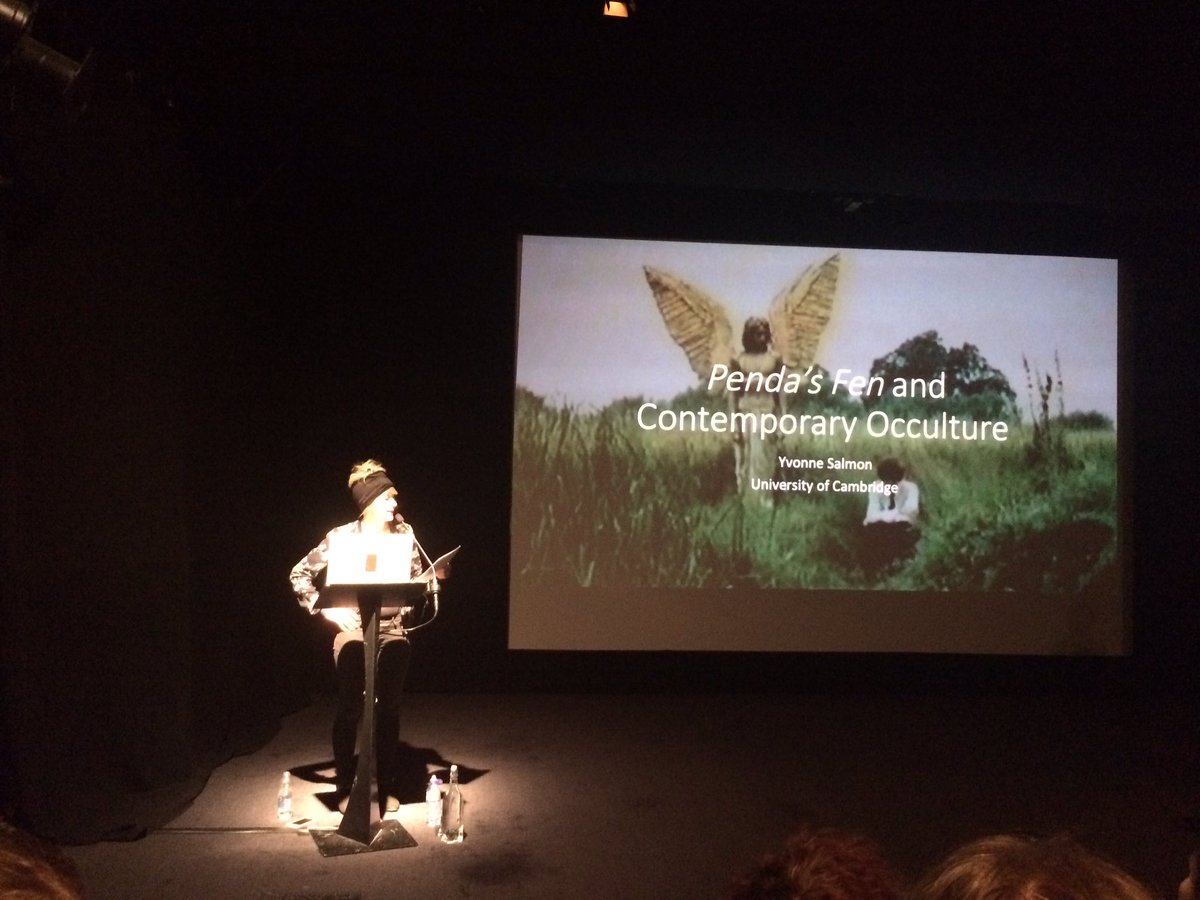
Yvonne Salmon at the BFI
In June, Yvonne Salmon was invited to take part in 'Child Be Strange', a special one-day symposium at the British Film Institute looking at Alan Clarke's Penda's Fen (1974). Yvonne spoke on 'Penda's Fen and Contemporary Occulture'. A publication from Strange Attractor Press is forthcoming. Original event flyer text added below.
*
Child Be Strange: A Symposium on Penda's Fen.Featuring a Q&A with screenwriter David Rudkin Including contributions from: Roger Luckhurst (Birkbeck), Yvonne Salmon (Cambridge University), Will Fowler (BFI), Gareth Evans (Whitechapel Gallery), and more tbc. When Alan Clarke’s Penda’s Fen was first broadcast in 1974 as a BBC ‘Play for Today’, The Times commented that it was a “major work of television” and praised David Rudkin’s writing for its “beauty, imagination and depth.” Including the film in its 2011 selection of the best 100 British films, Time Out magazine described Penda's Fen as a “multi-layered reading of contemporary society and its personal, social, sexual, psychic and metaphysical fault lines.” It has since been recognized as an extraordinary contribution to 1970s counter-cultural investigations of alternative ‘pagan’ histories of landscape, myth, theology and psyche at a crucial transitional moment in post-war Britain. The film vanished into unseen cult status, but after decades of unavailability the BFI has released Penda’s Fen on Blu-ray and DVD. This one-day symposium seeks to bring together academics, writers, and artists from across different fields to excavate this weird and wonderful cultural artefact. |
Showing posts with label publications. Show all posts
Showing posts with label publications. Show all posts
Child Be Strange / Penda's Fen
Headlands
One of our ongoing projects is Headlands. This has been developed and designed by Yvonne Salmon and James Riley as a multi-platform work encompassing expanded cinema, spoken word, field research, a curated exhibition and various publications.
The project looks at the folkloric and ufological intersections that exist between two villages in North Cornwall: Port Isaac and St. Teath.
We mounted the project as an exhibition at the Faculty of English, University of Cambridge from 23rd June to 11th July 2016. This was followed by an live event at the Festival of Ideas on October 22nd, 2017. A trailer for the live event can be found here. We are now preparing the piece for release as a book and album on Eighth Climate Records. Further live performances are planned for the future . Scroll down for images and the promotional text for the original exhibition.
In 2015 Yvonne Salmon and James Riley travelled through North Cornwall. They went in search of evidence pertaining to two fictional and folkloric events: the filming of the sci-fi drama The Nightmare Man (1981) in Port Isaac and the 1645 'abduction' of Ann Jefferies from the nearby hamlet of St. Teath.
A series of material and symbolic factors connect these two episodes. They also lie at the intersection of place, culture and myth that characterises Cornwall's particular psychic territory.
Influenced by Patrick Keiller and the Robinson Institute, Headlands presents a series of texts, images and magical objects. Drawing on Yvonne Salmon's work as an artist and James Riley's experience with private archives, it is intended as an essay by way of artefacts, a dispatch from the zone.
You can see this exhibition on the first floor landing of the English Faculty building from 23rd June to 11th July 2016.
Yvonne Salmon and James Riley will be on the first floor landing at 1pm on Thursday 30th June. They will be happy to talk through the exhibition with any interested parties.
Headlands is presented as an output of the ongoing research project The Alchemical Landscape. It has been timed to coincide with 'The Alchemical Landscape II: Screen Media, Occulture and the Geographic Turn', a one day symposium at Girton College, Cambridge on 7th July. An event linked to the Headlands exhibition will be presented as part of the 2016 Festival of Ideas. The Alchemical Landscape Project has been awarded CRASSH research group status and will run a seminar series during the academic year 2016-2017.
The project looks at the folkloric and ufological intersections that exist between two villages in North Cornwall: Port Isaac and St. Teath.
We mounted the project as an exhibition at the Faculty of English, University of Cambridge from 23rd June to 11th July 2016. This was followed by an live event at the Festival of Ideas on October 22nd, 2017. A trailer for the live event can be found here. We are now preparing the piece for release as a book and album on Eighth Climate Records. Further live performances are planned for the future . Scroll down for images and the promotional text for the original exhibition.
*
 |
| Headlands Hotel, Port Isaac, Cornwall |
 |
| Tintagel, Cornwall |
 |
| Field work: Salmon shooting in St. Teath |
*
Headlands - A New Exhibition on the First Floor
In 2015 Yvonne Salmon and James Riley travelled through North Cornwall. They went in search of evidence pertaining to two fictional and folkloric events: the filming of the sci-fi drama The Nightmare Man (1981) in Port Isaac and the 1645 'abduction' of Ann Jefferies from the nearby hamlet of St. Teath.
A series of material and symbolic factors connect these two episodes. They also lie at the intersection of place, culture and myth that characterises Cornwall's particular psychic territory.
Influenced by Patrick Keiller and the Robinson Institute, Headlands presents a series of texts, images and magical objects. Drawing on Yvonne Salmon's work as an artist and James Riley's experience with private archives, it is intended as an essay by way of artefacts, a dispatch from the zone.
You can see this exhibition on the first floor landing of the English Faculty building from 23rd June to 11th July 2016.
Yvonne Salmon and James Riley will be on the first floor landing at 1pm on Thursday 30th June. They will be happy to talk through the exhibition with any interested parties.
Headlands is presented as an output of the ongoing research project The Alchemical Landscape. It has been timed to coincide with 'The Alchemical Landscape II: Screen Media, Occulture and the Geographic Turn', a one day symposium at Girton College, Cambridge on 7th July. An event linked to the Headlands exhibition will be presented as part of the 2016 Festival of Ideas. The Alchemical Landscape Project has been awarded CRASSH research group status and will run a seminar series during the academic year 2016-2017.
Black Mirror 2: Elsewhere
 |
| Black Mirror 0: Territory |
Our friends at the Black Mirror Network are preparing volume 2 in their publication series. See below for their circulated Call for Papers.
*
"We are now seeking written contributions for the next volume
in the Black Mirror series: Black Mirror 2 – Elsewhere. This volume will
examine how the inner world of visions,
spirits, dreams and magic has been explored by contemporary and modern artists,
film makers and other cultural practitioners (1900 – present day).
Contributions which cover altered states, trance, dreams, visions,
hallucinations, entheogens, magical ritual, shamanic practice, the ensouled
landscape, the spirit world, and related themes in relation to artistic and
cultural practice are welcome.
We are seeking written contributions about the work of
artists and cultural practitioners (please note that we are not seeking purely
visual contributions or contributions from artists writing about their own work
at this stage). Eventual contributions should be between 4000 – 7000 words. If
you would like to contribute, please submit an abstract of not more than 400
words to: http://aub.ac.uk/research/black-mirror/ to arrive no later than 15th
February 2016. We will select contributions and notify successful contributors
by the end of February. The deadline for receipt of full contributions will be
13th May 2016. All contributions will be peer-reviewed. The intended
publication date for Black Mirror 2 – Elsewhere is October 2016.
The Black Mirror series is produced by the Black Mirror
Research Network, which is a partnership between the Arts University
Bournemouth (UK), NYU Steinhardt (US) and publisher Fulgur Esoterica. The
network exists to explore the relationships between contemporary and modernist
arts and the occult, esoteric, magic and enchantment. The editors of the Black
Mirror series are Robert Ansell (Fulgur), Jesse Bransford (NYU Steinhardt),
Judith Noble and Dominic Shepherd (both Arts University Bournemouth).
Black Mirror is
recasting the model of the traditional academic publication. Our volumes have
very high production values; we emphasis the examination of visual work and so
publish in full colour with extensive images and illustrations. Each volume
includes portfolio and other visual contributions by artists. Contributions are
licensed from contributors and ownership is released back to them after a
reasonable period of time."
*
For more information on the Black Mirror Network, see their website. Their brief bio can be seen below:
"The Black Mirror Research Network is a partnership between
the Arts University Bournemouth (UK), NYU Steinhardt (US) and publisher Fulgur
Esoterica. The network was founded in 2013 by Associate Professors Judith Noble
and Dominic Shepherd (AUB) and Robert Ansell (Fulgur Esoterica) to examine the
relationships between contemporary/ modernist arts and cultural practice and
the esoteric, occult and enchantment. In 2015 we were delighted to welcome NYU
Steinhardt, in the person of Professor Jesse Bransford, to the partnership. The network is an international project with members from
across Europe and the US. We are currently working on the third in a series of
peer-reviewed volumes and are preparing a bid for research funding in the UK. Black
Mirror has curated one live arts event (Absolute Elsewhere 2014) and will
curate an exhibition in the AUB in 2017."
Canals

Over at Residual Noise, James Riley has posted 'Ghosts Everywhere', a short essay about canals, Susan Hill and borderlands. It's something of a partner text to the earlier post, Horror Story.

Intellectual Barbarians: The Kibbo Kift Kindred

Intellectual Barbarians: The Kibbo Kift Kindred is an exhibition at The Whitechapel Gallery running until March 2016. It explores the creative output of The Kibbo Kift Kindred (1920-1932), a progressive English organisation whose idealistic ambitions for world peace were rooted in a shared appreciation of nature and handicraft. The exhibition coincides with the publication of The Kindred of the Kibbo Kift (Donlon Books, 2015), an exhaustive full-length study of the group by co-curator Dr. Annebella Pollen (University of Brighton). Follow the links for full press releases and further information.
Robert Macfarlane article in The Guardian

Its been interesting to see some of the responses to the article. There's a post over at Sound Mirrors that makes links to Beckett and a few other artists of within the field. Brian Baker at SF 365 has also posted an excellent critical response to both Robert's article and the Alchemical Landscape symposium. Brian was one of our presenters who delivered a brilliant paper on Alan Garner. In his post, 'Landscape and (science) (fiction) (fantasy)', Brian rightly reflects on a number of the issues that arose in the open forum sessions during the symposium and which arguably emerged as meta-narratives as the day went on. Certainly the entanglement of geography, gender and nationhood; the frequently ambiguous intersection of identity, 'home' and ideology as well as the politics of place are all issues that we are keen to elucidate and interrogate as the project develops.
Subscribe to:
Posts (Atom)