 |
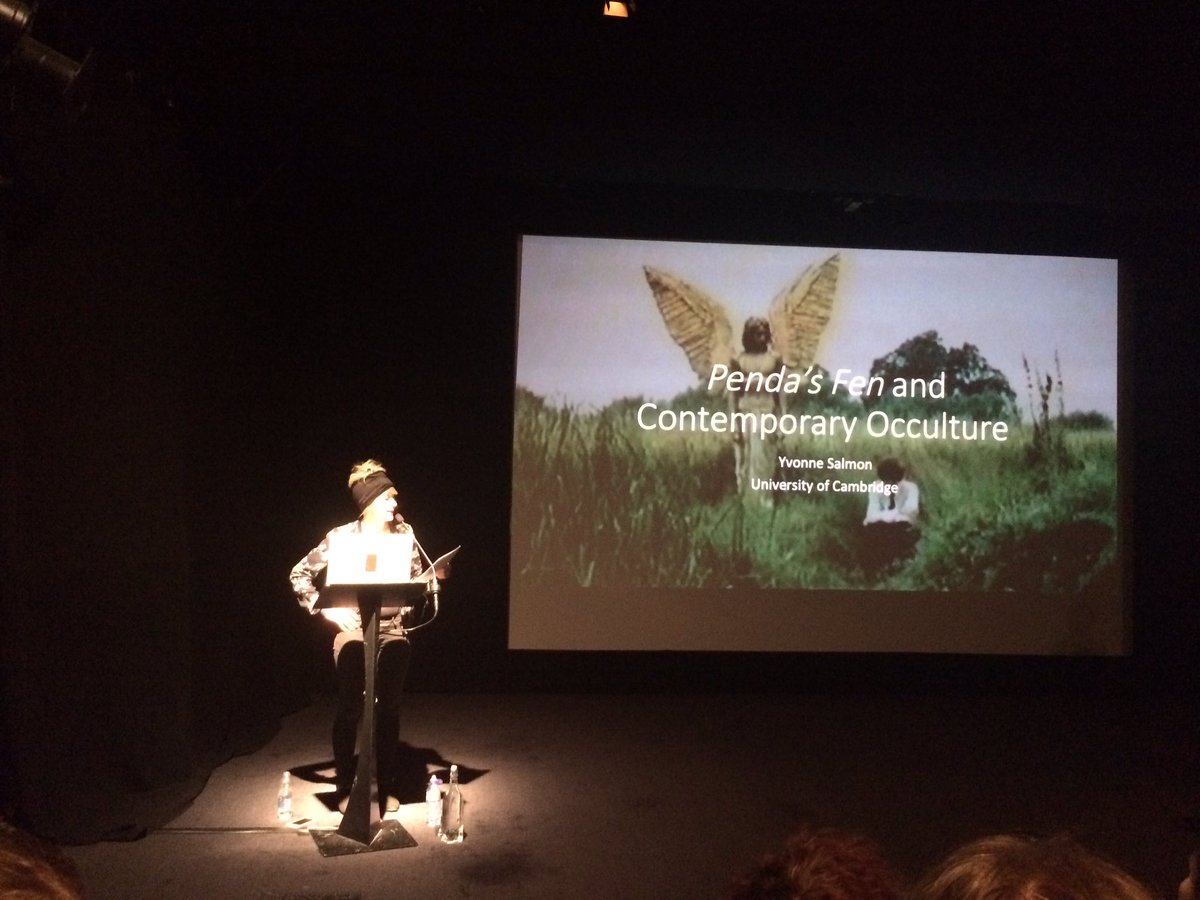
Yvonne Salmon at the BFI
In June, Yvonne Salmon was invited to take part in 'Child Be Strange', a special one-day symposium at the British Film Institute looking at Alan Clarke's Penda's Fen (1974). Yvonne spoke on 'Penda's Fen and Contemporary Occulture'. A publication from Strange Attractor Press is forthcoming. Original event flyer text added below.
*
Child Be Strange: A Symposium on Penda's Fen.Featuring a Q&A with screenwriter David Rudkin Including contributions from: Roger Luckhurst (Birkbeck), Yvonne Salmon (Cambridge University), Will Fowler (BFI), Gareth Evans (Whitechapel Gallery), and more tbc. When Alan Clarke’s Penda’s Fen was first broadcast in 1974 as a BBC ‘Play for Today’, The Times commented that it was a “major work of television” and praised David Rudkin’s writing for its “beauty, imagination and depth.” Including the film in its 2011 selection of the best 100 British films, Time Out magazine described Penda's Fen as a “multi-layered reading of contemporary society and its personal, social, sexual, psychic and metaphysical fault lines.” It has since been recognized as an extraordinary contribution to 1970s counter-cultural investigations of alternative ‘pagan’ histories of landscape, myth, theology and psyche at a crucial transitional moment in post-war Britain. The film vanished into unseen cult status, but after decades of unavailability the BFI has released Penda’s Fen on Blu-ray and DVD. This one-day symposium seeks to bring together academics, writers, and artists from across different fields to excavate this weird and wonderful cultural artefact. |
Showing posts with label film. Show all posts
Showing posts with label film. Show all posts
Child Be Strange / Penda's Fen
Ben Wheatley / Freefire
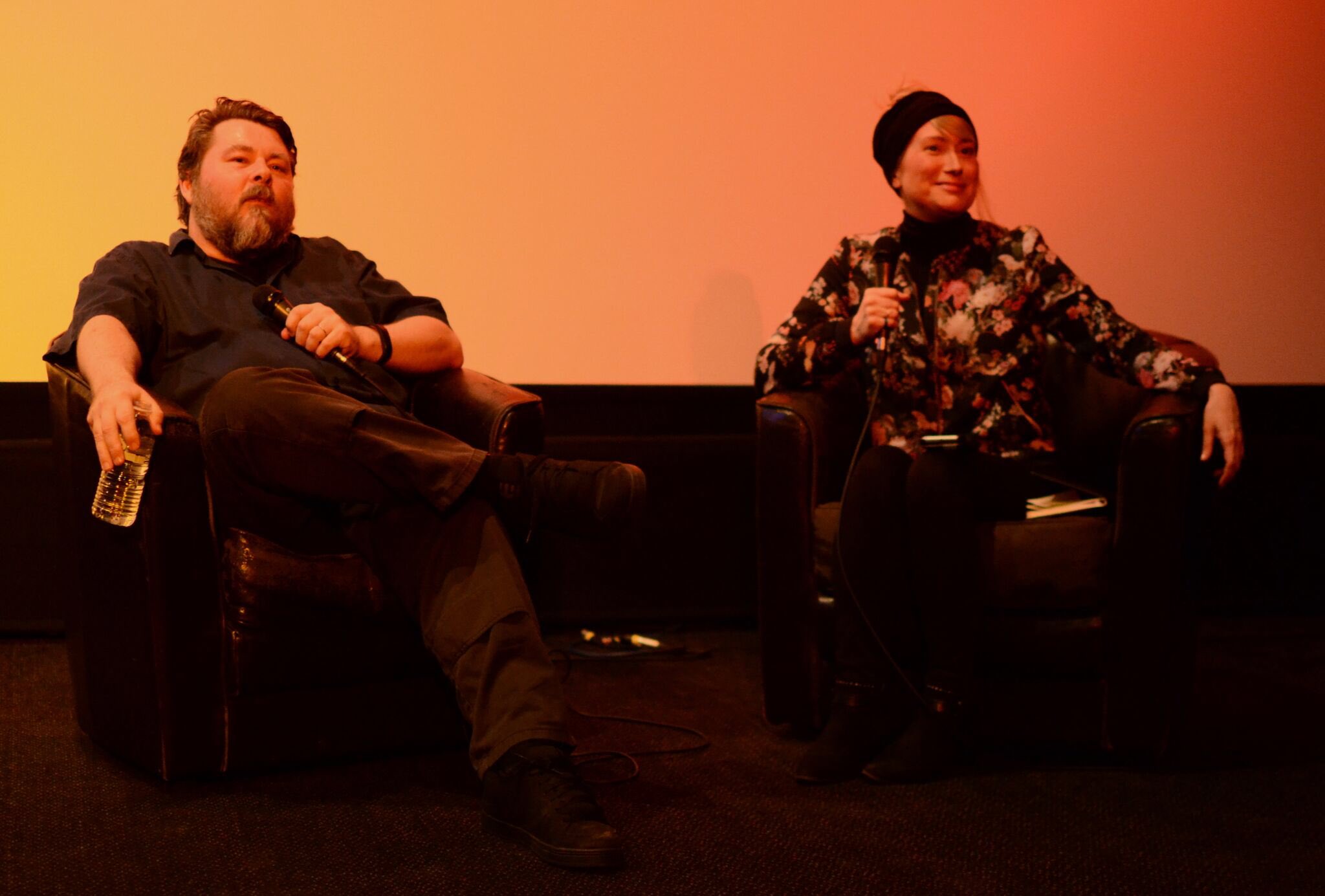 |
Ben Wheatley and Yvonne Salmon in conversation at the Picturehouse, Cambridge. Image: Picturehouse via Twitter.
Yvonne Salmon was delighted to be invited to interview Ben Wheatley as part of his promotional tour to support Freefire (2017). The sell-out event on March 30th generated some fabulous questions and the film was very well received. Having instigated the Alchemical Landscape project with a special screening and symposium on A Field in England (2013), and previously organised a Q+A to support High Rise (2016) Salmon is an expert on Wheatley's work.
|
Invisible Landscapes
We were very happy to work with Yelena Popova on Invisible Landscapes, a joint screening of video works. This was held at the Grange Cottage at Girton College as part of Yelena's artistic residency at Cambridge. Scroll down for the original event flyer text.
 |
Still from Ghost Walk.
*
INVISIBLE LANDSCAPES:
An Evening of Short Films by Yelena Popova, Yvonne Salmon & James Riley.
7pm Thursday 4th May, Grange Cottage Studio, Girton College Main Site.
Invisible Landscapes is a curated film programme featuring work by
Girton's Artist in Residence Yelena Popova and the directors of the
ongoing Alchemcial Landscape project, Yvonne Salmon & James Riley.
With a shared interest in landscape, architecture and psychogeography,
these films use word and image to look at some of the hidden forces
that underpin our notions of place.
Films to be shown include:
Yelena Popova:
Particulate Matter, Unnamed.
Yvonne Salmon & James Riley: Ghost Walk, Distress Signals, Territories, The Bird, Codebreaker.
The screening will be introduced by the film-makers and will feature a
short Q+A session.
All welcome.
|
Headlands
One of our ongoing projects is Headlands. This has been developed and designed by Yvonne Salmon and James Riley as a multi-platform work encompassing expanded cinema, spoken word, field research, a curated exhibition and various publications.
The project looks at the folkloric and ufological intersections that exist between two villages in North Cornwall: Port Isaac and St. Teath.
We mounted the project as an exhibition at the Faculty of English, University of Cambridge from 23rd June to 11th July 2016. This was followed by an live event at the Festival of Ideas on October 22nd, 2017. A trailer for the live event can be found here. We are now preparing the piece for release as a book and album on Eighth Climate Records. Further live performances are planned for the future . Scroll down for images and the promotional text for the original exhibition.
In 2015 Yvonne Salmon and James Riley travelled through North Cornwall. They went in search of evidence pertaining to two fictional and folkloric events: the filming of the sci-fi drama The Nightmare Man (1981) in Port Isaac and the 1645 'abduction' of Ann Jefferies from the nearby hamlet of St. Teath.
A series of material and symbolic factors connect these two episodes. They also lie at the intersection of place, culture and myth that characterises Cornwall's particular psychic territory.
Influenced by Patrick Keiller and the Robinson Institute, Headlands presents a series of texts, images and magical objects. Drawing on Yvonne Salmon's work as an artist and James Riley's experience with private archives, it is intended as an essay by way of artefacts, a dispatch from the zone.
You can see this exhibition on the first floor landing of the English Faculty building from 23rd June to 11th July 2016.
Yvonne Salmon and James Riley will be on the first floor landing at 1pm on Thursday 30th June. They will be happy to talk through the exhibition with any interested parties.
Headlands is presented as an output of the ongoing research project The Alchemical Landscape. It has been timed to coincide with 'The Alchemical Landscape II: Screen Media, Occulture and the Geographic Turn', a one day symposium at Girton College, Cambridge on 7th July. An event linked to the Headlands exhibition will be presented as part of the 2016 Festival of Ideas. The Alchemical Landscape Project has been awarded CRASSH research group status and will run a seminar series during the academic year 2016-2017.
The project looks at the folkloric and ufological intersections that exist between two villages in North Cornwall: Port Isaac and St. Teath.
We mounted the project as an exhibition at the Faculty of English, University of Cambridge from 23rd June to 11th July 2016. This was followed by an live event at the Festival of Ideas on October 22nd, 2017. A trailer for the live event can be found here. We are now preparing the piece for release as a book and album on Eighth Climate Records. Further live performances are planned for the future . Scroll down for images and the promotional text for the original exhibition.
*
 |
| Headlands Hotel, Port Isaac, Cornwall |
 |
| Tintagel, Cornwall |
 |
| Field work: Salmon shooting in St. Teath |
*
Headlands - A New Exhibition on the First Floor
In 2015 Yvonne Salmon and James Riley travelled through North Cornwall. They went in search of evidence pertaining to two fictional and folkloric events: the filming of the sci-fi drama The Nightmare Man (1981) in Port Isaac and the 1645 'abduction' of Ann Jefferies from the nearby hamlet of St. Teath.
A series of material and symbolic factors connect these two episodes. They also lie at the intersection of place, culture and myth that characterises Cornwall's particular psychic territory.
Influenced by Patrick Keiller and the Robinson Institute, Headlands presents a series of texts, images and magical objects. Drawing on Yvonne Salmon's work as an artist and James Riley's experience with private archives, it is intended as an essay by way of artefacts, a dispatch from the zone.
You can see this exhibition on the first floor landing of the English Faculty building from 23rd June to 11th July 2016.
Yvonne Salmon and James Riley will be on the first floor landing at 1pm on Thursday 30th June. They will be happy to talk through the exhibition with any interested parties.
Headlands is presented as an output of the ongoing research project The Alchemical Landscape. It has been timed to coincide with 'The Alchemical Landscape II: Screen Media, Occulture and the Geographic Turn', a one day symposium at Girton College, Cambridge on 7th July. An event linked to the Headlands exhibition will be presented as part of the 2016 Festival of Ideas. The Alchemical Landscape Project has been awarded CRASSH research group status and will run a seminar series during the academic year 2016-2017.
Upcoming Event: The Alchemical Landscape II
 |
| Image: James Riley |
This will be held at Girton College, University of Cambridge on Thursday 7th July, 2016.
Further details and the final programme can be found at the
Symposium II page.

High-Rise

High Rise +
Q&A with Producer Jeremy Thomas & Yvonne Salmon
Cambridge Picturehouse,
Saturday 12th March, 6.00pm
Saturday 12th March, 6.00pm
We are delighted to welcome renowned producer Jeremy Thomas
for a Q&A
with Cambridge
University
"The brutalism begins with the architecture and extends
all the way
down to the residents." - Variety
"The kind of cinematic madness we desperately
need." - The Independent
"Serves up an orgiastic mayhem on a silver
platter." - The Telegraph
J. G. Ballard’s dystopian novel about society disintegrating
within a
giant tower block is brought to the screen by the maverick
writer-director partnership of Amy Jump and Ben Wheatley (Kill
List, Sightseers).
Awarded his biggest budget yet, Wheatley ushers on
board established stars and ace production designer Mark
Tildesley (The
Constant Gardener, 28
Days Later). Dr Robert Laing (Tom Hiddleston), an
affluent new tenant of the titular high-rise, quickly
attracts the
attentions of neighbour Charlotte (Sienna Miller) and then
of Helen
(Elisabeth Moss), who happens to be married to the socially
stratified
community’s resident troublemaker (Luke Evans).
As tensions build, the brutalist tower that its architect (a
supremely
laconic Irons) imagined would be “a crucible for change”
gradually
descends into anarchy in this great-looking, darkly
hilarious drama.
To book your ticket to the event, click here:
Interview: Festival of Ideas 2015
 |
| Festival of Ideas image used to promote the event |
As part of the 2015 Festival of Ideas at the University of Cambridge, we were invited to put on a talk relating to The Alchemical Landscape project. The event, a joint lecture by Yvonne Salmon and James Riley, drew a standing-room-only crowd. There must have been something in the air as not too far away various comrades were mounting a similar expedition into the English Eerie.
The Festival of Ideas kindly included us as part of their 'Speaker Spotlight' profile series. We gave a short interview that appeared on the Festival website ahead of the event. Full text reproduced below. Many thanks to all who came to the talk and may thanks indeed to the Festival for having us on board.
*
CFI: What exactly is being ‘revived’ by the artists you study?
YS: In essence, a visionary – if not mystical – understanding of the environment. The link between landscape and magical thought is, of course, ancient: seasonal observances, ritual practices and any number of festive traditions work as points of mediation between human consciousness and ‘nature’ (broadly understood). We’re not claiming this connection as part of a ‘new’, hitherto unknown, cultural current. Rather, we’re interested in contemporary artists who draw on this resonant history in order to prioritise representations of the rural, where we might expect to find engagements with urban space and associated contexts of ‘modernity’. Examples would be Iain Sinclair who in his study of John Clare, Edge of the Orison (2005) turned his psychogeographic gaze from the density of London to the Essex flatlands. Patrick Keiller does something similar in his film Robinson in Ruins (2010). After interrogating urban and industrial spaces in London (1994) and Robinson in Space (1997) he has his title character disappear in the countryside in an attempt to commune with “non-human intelligences”. Basically, The Alchemical Landscape begins where Jez Butterworth’s play Jerusalem (2009) ends. Keeping in mind ‘Rooster’ Byron’s extraordinary exhortation to the gods of the earth, the project looks for artists working in a similar mode and considers the effects – creative, aesthetic and political – of such an invocation.
JR: I see this trend as representing, in part, a revival of interest in the work of authors such as John Michell. His The View Over Atlantis (1969) did much to promote public interest in ley lines, sacred geometry and other ‘earth mysteries’. Michell’s work along with that of T.C Lethbridge and Nigel Pennick has its own extensive cultural history. My point of interest lies in the use made of these ideas by a pre and post millennial generation of writers and musicians. That’s to say, what’s going on when Julian Cope puts together a double album of psychedelic rock dedicated to Lethbridge, featuring Colin Wilson and which uses dowsing as a central theme?
CFI: Why do you think there has been such a revival?
JR: Environmental change. Consciously or not, much of the material we’ve been thinking about deals with the close intersection between ecology and psychology. All the ghosts that appear in works such as Chris Lambert’s Tales from the Black Meadow(2013) seem to be the spectral residue of a lost pastoral space. Certainly, the closer we move to the conditions of John Barr’s Derelict Britain (1969), the more this type of work is produced.
YS: Home and habitation is another key theme. I don’t think it is any surprise that in this era of zombie properties, zero hour contracts and precariat economics there has been a significant investment in psychic spaces. The Haunted Shoreline project is a good example of this: an exploration of an imaginative and very personal locality.
CFI: What is it about the British landscape that inspires artists to invest it with magic and the occult?
YS: You could say that the landscape needs little actual investment in this regard. Super- and supra-natural forces are deeply, deeply entwined into the fabric of the earth. Whether you interpret these ‘energies’ in folkloric terms or in terms of Keiller’s “non-human intelligences” both discourses speak of that which is occulted: systems and processes ‘hidden’ under the surface of a given landform or forest floor.
CFI: How has this revival influenced other creative forms?
JR: Delaine Le Bas’ multi-platform project Witch Hunt (2011) shows what can be achieved as a result of combining these ideas with film, installation and performance. It’s a brilliant multimedia essay on home, homelessness and Romany folklore.
YS: Probably because music is inherently haunting, you’ve got labels like Ghost Box and The Outer Church releasing records that tie directly into ideas of occult geography. There’s a line to be drawn here from English Psychedelia to rave culture and then to albums like Farmer’s Angle (2004) by Belbury Poly.
CFI: Are there specific geographic areas in the UK where this is most prolific?
JR: The shadow of M.R. James looms large over the Suffolk and Norfolk coasts and the Devon and Cornwall border has given rise to some brilliant works such as Jon Akomfrah’s Tropikos (2014). Drew Mullholland has used several works to build up a dense and allusive soundscape of Glasgow.
YS: Each county and territory has its charged spaces, the points where lines converge, as it were. Some, like Glastonbury Tor are highly visible and well established in the public consciousness. Others, like the River Fleet are literally buried out of sight. Peter Underwood had the right idea with his Gazetteer of haunted houses and ghost sites across the country and I’m glad the tradition is continuing with the blog The Wyrd England Gazetteer. The UK is a group of extremely haunted islands. We should be trying to map this entire territory rather than surveying a single location.
CFI: Are we losing a sense of connection with the landscape as we lose our sense of mysticism and magic in this age of super-fast technological advancement?
JR: Yes and no….
YS: Many of the artists discussed create beautiful artefacts that seem to be specifically designed to stand in opposition to the virtual. However, I think much of this work has been made possible because of the digital economy.
JR: Most of the artists we’re dealing with are expert social networkers. If anything, this field is a product of the blogosphere.
CFI: Which book, film or piece of music best illustrates what you will be speaking about?
YS: The catalyst for the project was the success of a symposium I organised on Ben Wheatley’s A Field in England (2013). I’d say that was an essential text. Also, you can see traces of Derek Jarman’s Super-8 film A Journey to Avebury (c.1971) in much of the material we’re going to be speaking about.
JR: On that note, you can’t forget the deeply unsettling serial Children of the Stones(1977). Shot in Avebury, It’s the weird, hauntological flipside to Jarman’s film and a touchstone for many of the artists on the Ghost Box label.
Holloway

Rob Macfarlane and Adam Scovell recently teamed up with James Bulley, Stanley Donwood and Richard Skelton to make the 9-minute Jarman homage, Holloway. A spectral mix of Journey to Avebury, Scovell's previous super-8 films and Macfarlane's meditation on the area, the film formally examines the palimpsestual nature of "the sunken lanes in South Dorset that are known as holloways."
Describing the project Macfarlane notes:
I had become fascinated by these strange folds of land: by the manner in which history seemed to repeat – re-pleat – itself within and around them, across centuries, and by the patterns of echo and loop that I perceived the holloways as somehow generating. Super-8 – Adam’s preferred stock – seemed the perfect film on which to shoot this subject, given its palimpsestic surface and its shivery rhythms. I wrote a text to be spoken as voiceover, which I tried to ingrain with doublings and reversals (of image, word, sound). We wanted to make a film that cast a brief strong spell.
The film is viewable, along with a longer version of the above over at Caught by the River. Scovell has also documented the gestation of the project on his website.
Sand

Further to the last post regarding hidden beaches and things buried, please do check out the first notes for English Heretic's new project-in-progress, Sand. The post carries some typically resonant writing linking J.G. Ballard with M.R. James and Charles Manson with Robert Graves. As with Ballard's 'The Terminal Beach' this initial essay points to the fertile territory where the dust of the earth meets the lowland of the mind.
Subscribe to:
Posts (Atom)